
Turn Buyer Hesitation into Predictable Revenue
Discover why buyers stall and what to do about it.
When Interest Doesn't Turn Into Revenue
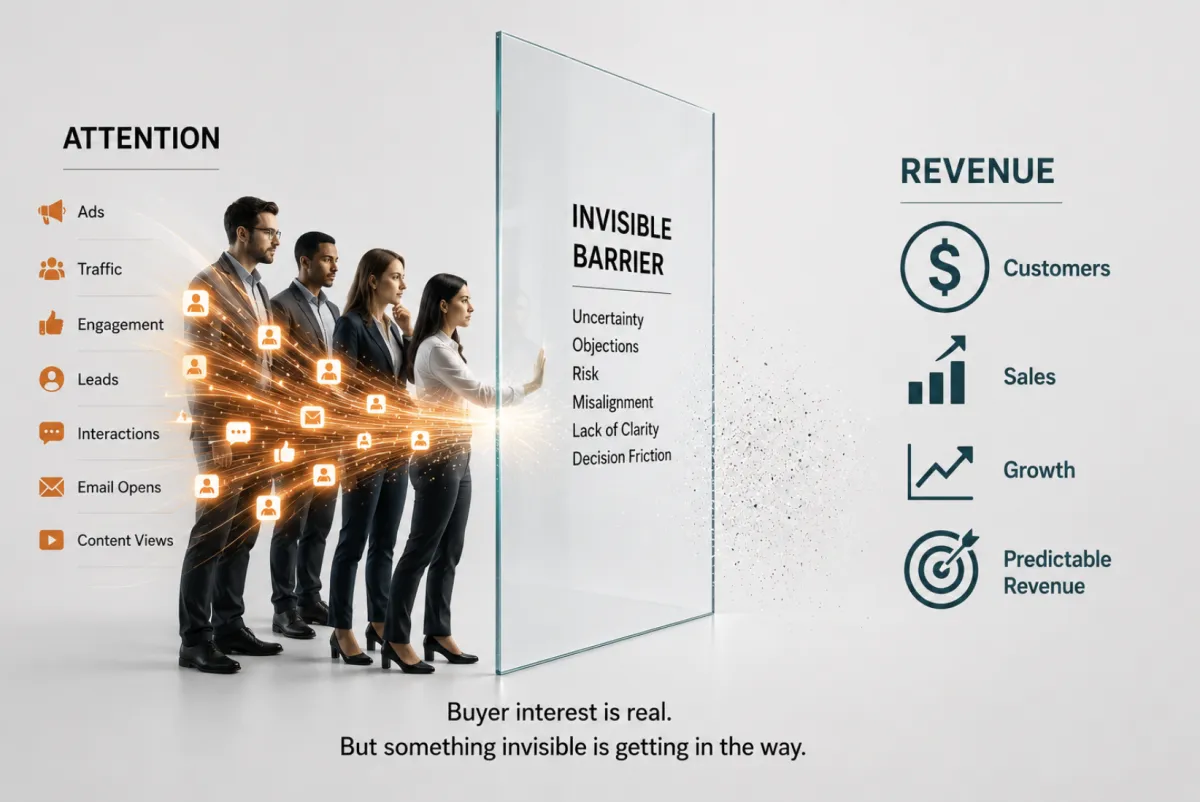
Your marketing is generating attention. But somewhere between interest and action, momentum breaks down.
The average B2B sales close rate (win rate on opportunities) is 20- 29% across industries.
71–80% of opportunities slow down, stall, or quietly lose momentum before a decision is made.
Potential buyers show interest. Conversations begin. Engagement looks promising. Then uncertainty creeps in.
Buyer decisions get delayed. Stakeholders hesitate. Momentum fades. And revenue that looked likely never materializes. It’s not only frustrating. It can be expensive!
The Hidden Problem
You drive traffic. You build funnels. You optimize campaigns. But revenue still fluctuates.
Same audience. Same strategy. Different outcome. Because attention alone doesn’t create buyers.
Something invisible is happening inside the buyer’s decision journey that makes moving forward feel risky, unclear, or overwhelming. In many cases, buyers aren’t rejecting your offer. They simply don’t feel confident enough to decide. And when uncertainty increases, buyer momentum slows.
The problem … Uncertainty.
Most businesses never see this happening because decision friction rarely announces itself directly. It quietly shows up as:
Delayed decisions
Inconsistent conversions
Stalled momentum
Lower response rates
Longer buying cycles
Interested, but not ready
And when this happens, performance becomes unpredictable and it affects your numbers and revenue forecasts.
It can also affect prospect trust and client retention.
When buyers hesitate and deals don't close, your strategy may get questioned. Not because you’re wrong. Because something invisible is happening inside the buyer’s decision process and you may not even be aware of it.
Most Buying Decisions Don’t Fail All at Once
Up to 60–70% of B2B deals end in "no decision." Buyers are more comfortable with the status quo, according to Corporate Visions.
Most B2B purchases involve 6–10 decision-makers. More stakeholders = More scrutiny. More perceived risk.
Momentum rarely disappears overnight. It slows gradually as uncertainty increases, stakeholders hesitate, priorities shift, and perceived risk grows. The more complex the decision, the more friction appears. Which means even strong marketing, strong messaging, and strong offers can lose momentum before buyers ever move forward.

GrowthByDesign AI reduces deal stalls and buyer hesitation
So More Interest Turns Into Revenue
Attention is Only the Beginning
What Most Consultants and Advisory Firms Miss
Most businesses optimizes for attention and interest. They create landing pages, funnels, webinars, and nuturture sequences. They focus on traffic, clicks, leads and sales calls. All designed to get buyers TO the decision.
But very few are guiding buyer THROUGH the decision.
And that's where revenue quietly disappears. Not from bad leads or lack of value. But because buyers experienced friction during the decision process. Buyers may not say "no." They say, "let me think about it."
Until that resistance is removed, more leads, more automation, or more marketing spend won’t fix the core issue.
A New Lens on Revenue Growth
You are responsible for driving results.
Buyer Decision Intelligence (BDI) helps businesses identify the hidden points where buyer momentum slows, hesitation increases, and decisions break down.
Think of it like visibility into the part of the customer journey most businesses can’t see.
While others focus only on conversion metrics, BDI reveals:
• Where momentum breaks — not just where deals drop in the CRM
• Why buyers hesitate at each stage (usually not what you think)
• What to change first to get decisions moving again
Powered by MODE OS.
M
MAP
Where buyer momentum
is slowing?
O
OBSERVE
Why are buyers stalling or hesitating?
D
DESIGN
What changes will
restore momentum?
E
EMBED
How do we make improvements scalable?
We help you see what others miss.
The Numbers Behind the Hesitation
60 - 70%
of B2B deals end in no decision, not lost to competitors, not reject - just never decided.
(Corporate Visions)
6 - 10
decision-makers are involved in the average B2B purchase — each capable of slowing the deal (Gartner)
13%
of buyers believe salespeople understand their needs. Confidence comes from feeling understood. (Edelman)
20 - 29%
average win rate. 7 in 10 qualified opportunities never close.
(Hubspot)
When decision friction is identified and removed, clients typically see:
10 -25%
lift in close rates
10 -20%
shorter sales cycle
15 - 30%
fewer stalled deals
5 - 15%
revenue lift,
no new traffic
Two Ways This Changes Your Business
1) Improve Revenue Performance Without Increasing Traffic
Identify what may be weakening buyer confidence, slowing decisions, or reducing conversion momentum before investing more into ads, funnels, or campaigns.
2) Differentiate Your Marketing Strategy
Most businesses compete for attention. Very few understand how to improve buyer decision momentum after attention is captured.
Buyer Decision Intelligence introduces a new way to understand why buyers hesitate and what helps them move forward.
A Clear Path Between Attention and Revenue
Before redesigning funnels, increasing ad spend, layering in AI tools, or rewriting messaging, you need visibility into what may be slowing buyer decisions. Because buyers rarely hesitate “for no reason.”
The signals already exist inside your messaging, positioning, offer, and buyer journey. You have to align these elements based on how your prospects make buying decisions. When you understand what’s creating uncertainty, you can sharpen clarity, strengthen trust, and create stronger buyer momentum.
Free: Buyer Choice Analyzer
See Why Buyers May Be Choosing Competitors
Instead of Choosing You
Most businesses don’t realize buyers may be choosing competitors long before a sales conversation ever happens. The Buyer Choice Analyzer reveals hidden gaps in your messaging, positioning, and offer that may be weakening buyer response, slowing momentum, or causing potential customers to hesitate before saying yes.
By taking this quick assessment, you'll discover:
Why buyers may choose competitors — even when your solution is better
What may be weakening trust, clarity, or perceived value in your messaging
Where buyer hesitation or decision friction may be hurting marketing performance
How your offer may look through the eyes of your ideal buyer
Before you spend more money on ads, content, or campaigns, see what may be preventing buyers from moving forward.
Buyer Decision Friction Diagnostic
Diagnoses exactly what's causing friction and what to do
A structured, expert-led assessment that maps where buying decisions stall, diagnoses what's causing hesitation, and delivers a prioritized plan to restore buyer momentum. You receive a visual Decision Stall Map, buyer friction analysis, ranked interventions by revenue impact, and a 30/60/90-day roadmap.
Buyer Decision Intelligence Engine™
Removes friction so you can create predictable revenue
The Diagnostic creates the blueprint. The Buyer Decision Intelligence Engine embeds decision architecture into your messaging, offers, CRM signals, and AI-powered workflows and buyer's journey. Buyer momentum becomes intentional, measurable, and scalable.
Requires completing the Buyer Decision Diagnostic first.
AI Growth Suite
AI execution tools and digital task team
The AI Growth Suite provides pre-built AI agents and workflows built for revenue teams. A separate collection of pre-built AI tools you can use independently. These AI tools were designed to support marketing, revenue, and customer growth initiatives without requiring advanced prompting or technical expertise. Select the option that best fits your needs.
Frequently Asked Questions
What is Buyer Decision Intelligence and how is it different from conversion rate optimization?
Buyer Decision Intelligence (BDI) is the practice of finding and fixing the hidden reasons why buyers stop moving forward even when they seem interested.
Think of it like this ... Most sales and marketing tools help you get more people to the door. BDI helps you understand why people stop right before they walk through it. Conversion rate optimization (CRO) improves things like button clicks, form fills, and page layouts. BDI goes deeper. It looks at what's happening inside the buyer's mind. Things like fear, doubt, and unclear next steps. CRO optimizes the path to the decision. BDI engineers the decision itself.
Why do B2B deals stall even when prospects seem interested?
Most of the time, B2B deals don't fall apart because of price or competition. They stall because the buyer is uncertain or doesn't have the confidence to move forward. Something inside the buying process makes saying "yes" feel risky.
Here are some reasons why the product, service or deal may cause the buyer to hesitate:
- Fear of making the wrong call.
- Too many people inside the company need to agree or buy in to the purchase.
- The buyer doesn't fully trust the outcome yet.
Research from Corporate Visions shows that 60–70% of B2B deals end in "no decision". The buyer took no action. The buyer was interested. The decision just never happened. Finding and removing that hidden resistance at each stage of the buyer's journey is what gets deals moving again.
Who can benefit from Buyer Decision Intelligence (BDI)?
Buyer Decision Intelligence is built for anyone who sells something complex where the buyer has to think hard, involve other people, or take a real risk to say yes. That includes:
Revenue consultants and fractional CROs use BDI in two ways. First, as a smarter way to diagnose why their clients' deals are stalling and fix it fast. Second, as a premium paid service they offer clients directly. A Buyer Decision Diagnostic gives clients a clear picture of where and why deals slow down, along with a plan to fix it. That creates stronger results and bigger engagements.
B2B technology and SaaS companies face long sales cycles with multiple decision-makers. BDI helps them understand exactly where buyer confidence breaks down and what to change to close deals faster.
Professional services firms including consulting, legal, financial advisory, and HR thatsell high-trust, high-stakes solutions. Buyers hesitate because the risk feels personal. BDI helps these firms reduce that hesitation with the right message at the right moment.
Enterprise software and IT vendors deal with complex buying committees and long evaluation periods. BDI gives revenue teams a way to track buyer confidence across the group and know when to act.
Healthcare and MedTech companies navigate risk-heavy buying decisions where fear of making the wrong choice is high. BDI helps surface those fears early before they kill the deal.
If your buyers take a long time to decide, involve multiple people, or regularly go quiet right before the finish line, Buyer Decision Intelligence was built for your sales cycle.
What causes decision friction in B2B sales cycles?
Decision friction is anything that makes a buyer feel like it's safer to wait than to move forward. It's not always something they say out loud. In fact, most of the time they don't say anything at all they just go quiet. The most common causes are:
- Fear that the risk outweighs the reward
- Confusion about what happens after they say yes
- Disagreement among the people inside their company who have to approve the deal
- Not enough proof at the moment they need it most
- Next steps that feel too complicated or unclear.
Because none of this shows up in your CRM or pipeline report, it's almost impossible to see, which is exactly why deals stall without an obvious reason. That's what Buyer Decision Intelligence is designed to find.
What results can B2B companies expect after addressing buyer decision friction?
When decision friction is found and removed, the results show up fast and they compound over time. B2B companies and their consultants typically see a 10–25% lift in close rates, 10–20% shorter sales cycles, 15–30% fewer stalled deals, and 5–15% more revenue without spending more on ads or traffic. Why? Because the real leak in the pipeline gets fixed. Instead of pouring more leads into a broken process, the process itself works better. And the longer decision intelligence is built into the revenue system, the more predictable results become. Less guessing. Less volatility. More control.